Note
Go to the end to download the full example code.
Fusing incomplete multi-modal representations
The imml.fuse module contains PyTorch modules for combining modality representations, even when not all
modalities are available, after each modality has been encoded into a shared feature space. This tutorial
shows common fusion strategies.
What you will learn:
How aggregate fusion modules combine list of tensors with shape
(batch_size, n_features).How
ConcatFusiondiffers from aggregate fusion modules.How
AttentionFusionlearns feature-wise modality weights.How
EmbraceNetsamples available modalities when some representations are missing.
# sphinx_gallery_thumbnail_number = 1

# License: BSD 3-Clause License
Step 1: Import required libraries
import pandas as pd
import torch
import matplotlib.pyplot as plt
import lightning as L

from imml.fuse import AttentionFusion, ConcatFusion, EmbraceNet, MaxFusion, MeanFusion, SumFusion
Step 2: Create modality representations
In a deep multi-modal model, these tensors would usually be produced by modality-specific encoders. For this tutorial, we create small synthetic embeddings directly. A row of NaNs denotes a missing modality for that sample.
random_state = 42
L.seed_everything(random_state)
n_modalities = 3
batch_size = 6
n_features = 4

Xs = [torch.randn(batch_size, n_features) for _ in range(n_modalities)]
Xs[0][2] = torch.nan
Xs[1][4] = torch.nan
Xs[2][1] = torch.nan
Seed set to 42
Step 3: Aggregate fusion
MeanFusion, SumFusion, and MaxFusion return one fused representation per sample and preserve the shared
feature dimension.
aggregate_fusions = {
    "mean": MeanFusion(),
    "sum": SumFusion(),
    "max": MaxFusion(),
}
aggregate_outputs = {name: fusion(Xs) for name, fusion in aggregate_fusions.items()}

for name, output in aggregate_outputs.items():
    print(name, output.shape)
mean torch.Size([6, 4])
sum torch.Size([6, 4])
max torch.Size([6, 4])
Step 4: Concatenation fusion
ConcatFusion receives a list of tensors, each with shape (batch_size, n_features), and concatenates them
along the feature axis. The output feature dimension is therefore n_modalities * n_features.
concat_fusion = ConcatFusion()
concat_output = concat_fusion(Xs)
print("concat", concat_output.shape)
concat torch.Size([6, 12])
Step 5: Attention fusion
AttentionFusion computes feature-wise scores for each modality and applies a softmax across modalities. During
training, the linear layer can learn which modalities should contribute more strongly to each feature.
attention_fusion = AttentionFusion(n_features=n_features)
attention_output = attention_fusion(Xs)

print("attention", attention_output.shape)
attention torch.Size([6, 4])
Step 6: EmbraceNet fusion
EmbraceNet assigns zero selection probability to missing modality rows when missing_values=0. The output is
stochastic because each feature can be sampled from a different available modality.
embracenet = EmbraceNet()
embrace_output = embracenet(Xs)
print("embracenet", embrace_output.shape)
embracenet torch.Size([6, 4])
Step 7: Compare fused representations
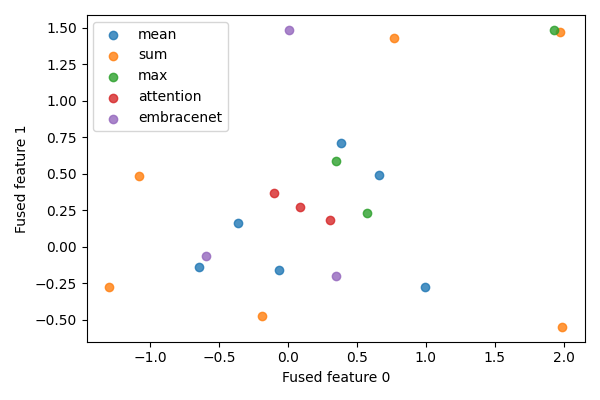
The fused embeddings have different scales and dimensions depending on the chosen strategy. The plot below compares the first two fused features for the aggregate methods and EmbraceNet.
fig, ax = plt.subplots(figsize=(6, 4))
plot_dict = {**aggregate_outputs, "attention": attention_output, "embracenet": embrace_output}
for name, output in plot_dict.items():
    values = output.detach().numpy()
    ax.scatter(values[:, 0], values[:, 1], label=name, alpha=0.8)
ax.set_xlabel("Fused feature 0")
ax.set_ylabel("Fused feature 1")
ax.legend()
fig.tight_layout()
Conclusion
Fusion modules provide interchangeable ways to combine modality representations. Aggregate modules keep the shared feature size, concatenation preserves all modality-specific features, attention learns feature-wise weights, and EmbraceNet can sample from available modalities when some inputs are missing.
Total running time of the script: (0 minutes 3.406 seconds)